|
<< 2 Samuel 6: Bringing up the Ark >>
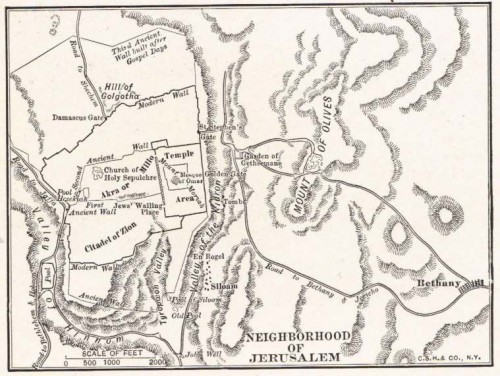
 Saul and Jonathan were dead, and David was king of all Israel, he had taken the strong fortress of the Jebusites on one of the hills of Jerusalem, and it was called "the city of David." Saul and Jonathan were dead, and David was king of all Israel, he had taken the strong fortress of the Jebusites on one of the hills of Jerusalem, and it was called "the city of David."
If you look at the map of Jerusalem, you see that the Kidron valley divides it from the Mount of Olives on the east. The valley of Hinnom comes down on the west of the city and joins the Kidron. Another smaller valley between these two separates Mount Moriah on the east, where the temple was afterwards built, from a higher hill on the west. This higher hill was rough and bold at its southern end, and it is this strong point that we think of when we read about the Jebusite fortress and Mount Zion. David made this his home and he built a palace here. He was now a strong king.
And where was the ark of the commandments at this time? Suppose you tell me its history from the time that it was made at Mount Sinai. Remember how its power was seen at the crossing of the Jordan, and how it threw down the walls of Jericho. After the land was conquered the ark rested in the tabernacle at Shiloh, and was there when Samuel ministered as a child. It was taken from Shiloh into the battle with the Philistines, and was in the hands of these enemies seven months. It came back on the cart drawn by the cows to Bethshemesh, and from there it was taken up to Kirjath-jearim among the hills of Judah. Kirjath-jearim, the "city of the woods," is thought to have been southwest of Jerusalem, at the ruin Arma, quite near Bethshesh. Here the ark rested a long time, some seventy or eighty years in all.
Now David gathered the people to bring up the ark to his city. We see them take it from its resting-place in Kirjath-jearim and place it on a cart drawn by oxen. We think of the new cart on which the Philistines put it, drawn by cows. But the ark did not reach Jerusalem. Why not? We must read how it was.
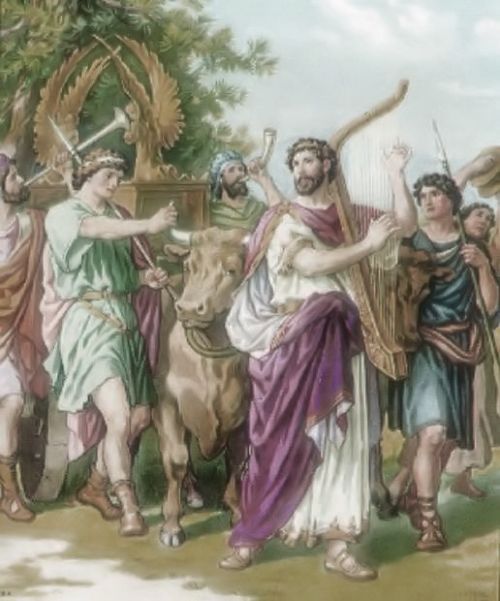
After three months David again gathered the people. This time there was no cart, but they took the ark gently on their shoulders as the priests used to do, and they brought it up safely to Jerusalem. We hear them singing and playing as they climb towards the city. David himself was dancing. But where should they put the ark? There was not yet any temple; the tabernacle was not in Jerusalem; but David had spread a tent for the ark in Mount Zion, and there they put it until the temple was built by Solomon.
This is the story of bringing up the ark.
Again, David gathered together all the chosen men of Israel, thirty thousand. And David arose, and went with all the people that were with him from Baale of Judah, to bring up from thence the ark of God, whose name is called by the name of the LORD of hosts that dwelleth between the cherubims. And they set the ark of God upon a new cart, and brought it out of the house of Abinadab that was in Gibeah: and Uzzah and Ahio, the sons of Abinadab, drave the new cart. And they brought it out of the house of Abinadab which was at Gibeah, accompanying the ark of God: and Ahio went before the ark.
 And David and all the house of Israel played before the LORD on all manner of instruments made of fir wood, even on harps, and on psalteries, and on timbrels, and on cornets, and on cymbals. And when they came to Nachon's threshingfloor, Uzzah put forth his hand to the ark of God, and took hold of it; for the oxen shook it. And the anger of the LORD was kindled against Uzzah; and God smote him there for his error; and there he died by the ark of God. And David was displeased, because the LORD had made a breach upon Uzzah: and he called the name of the place Perezuzzah to this day. And David was afraid of the LORD that day, and said, How shall the ark of the LORD come to me? So David would not remove the ark of the LORD unto him into the city of David: but David carried it aside into the house of Obededom the Gittite. And the ark of the LORD continued in the house of Obededom the Gittite three months: and the LORD blessed Obededom, and all his household. And it was told king David, saying, The LORD hath blessed the house of Obededom, and all that pertaineth unto him, because of the ark of God. So David went and brought up the ark of God from the house of Obededom into the city of David with gladness. And it was so, that when they that bare the ark of the LORD had gone six paces, he sacrificed oxen and fatlings. And David danced before the LORD with all his might; and David was girded with a linen ephod. So David and all the house of Israel brought up the ark of the LORD with shouting, and with the sound of the trumpet. And as the ark of the LORD came into the city of David, Michal Saul's daughter looked through a window, and saw king David leaping and dancing before the LORD; and she despised him in her heart. And David and all the house of Israel played before the LORD on all manner of instruments made of fir wood, even on harps, and on psalteries, and on timbrels, and on cornets, and on cymbals. And when they came to Nachon's threshingfloor, Uzzah put forth his hand to the ark of God, and took hold of it; for the oxen shook it. And the anger of the LORD was kindled against Uzzah; and God smote him there for his error; and there he died by the ark of God. And David was displeased, because the LORD had made a breach upon Uzzah: and he called the name of the place Perezuzzah to this day. And David was afraid of the LORD that day, and said, How shall the ark of the LORD come to me? So David would not remove the ark of the LORD unto him into the city of David: but David carried it aside into the house of Obededom the Gittite. And the ark of the LORD continued in the house of Obededom the Gittite three months: and the LORD blessed Obededom, and all his household. And it was told king David, saying, The LORD hath blessed the house of Obededom, and all that pertaineth unto him, because of the ark of God. So David went and brought up the ark of God from the house of Obededom into the city of David with gladness. And it was so, that when they that bare the ark of the LORD had gone six paces, he sacrificed oxen and fatlings. And David danced before the LORD with all his might; and David was girded with a linen ephod. So David and all the house of Israel brought up the ark of the LORD with shouting, and with the sound of the trumpet. And as the ark of the LORD came into the city of David, Michal Saul's daughter looked through a window, and saw king David leaping and dancing before the LORD; and she despised him in her heart.
And they brought in the ark of the LORD, and set it in his place, in the midst of the tabernacle that David had pitched for it: and David offered burnt offerings and peace offerings before the LORD. And as soon as David had made an end of offering burnt offerings and peace offerings, he blessed the people in the name of the LORD of hosts. And he dealt among all the people, even among the whole multitude of Israel, as well to the women as men, to every one a cake of bread, and a good piece of flesh, and a flagon of wine. So all the people departed every one to his house.---2 Samuel VI. 1-19.
The bringing up of the ark is still more real to us when we read a Psalm which was probably sung that day. We see the ark coming near to the city. The singers with David call to the gates to open. Other singers from the gates ask a question in answer, and the voices with David reply. This is the Psalm of rejoicing. It is printed in short lines because it is poetry, like all the Psalms.
A PSALM OF DAVID.
The earth is the LORD'S and the fulness thereof;
The world, and they that dwell therein.
For he hath founded it upon the seas,
And established it upon the floods.
Who shall ascend into the hill of the LORD?
Or who shall stand in his holy place?
He that hath clean hands, and a pure heart;
Who hath not lifted up hiis soul unto vanity.
Nor sworn deceitfully.
He shall receive the blessing from the LORD,
And righteousness from the God of his salvation.
This is the generation of them that seek him,
That seek Thy face O Jacob..[Selah.]
Lift up your heads, O ye gates;
And be ye lift up, ye everlasting doors;
And the King of glory shall come in.
Who is this King of glory?
The LORD strong and mighty,
The LORD mighty in battle.
Lift up your heads, 0 ye gates;
Even lift them up, ye everlasting doors;
And the King of glory shall come in.
Who is this King of glory?
The LORD of hosts,
He is the King of glory.[Selah.]
—Psalm XXIV.
Author: William L. Worcester 1904
Spiritual Correspondences
Ark with the Philistines >> The commandments are held as matters of knowledge and not obeyed
Ark returned upon the new cart >> Natural affections are in line with the commandments
Bring up the ark to the citadel of Zion >> Regeneration
Resting the ark in Kirjath-jearim >> Commandments kept as duty
Resting the ark in the house of Obed-edom >> Commandments kept with intelligent understanding of their meaning and purpose
Resting the ark in Mount Zion >> Commandments kept with the Love of the heart
Threshing-floor >> Temptation
Shaking of the ark >> Faltering of obedience in temptation
Uzzah putting forth his hand and taking hold of the ark >> Self-confidence and lack of true reverence and humility
Death of Uzzah >> Death of self-confidence
Music >> Joy of receiving commandments deeply into life
Mount Zion >> The heart's inmost love
Bringing up the Ark >> Ascent into Natural, Spiritual and Celestial Heavens
|
|