|
COLORS OF ANIMALS >> Conditions of Affections and Thoughts
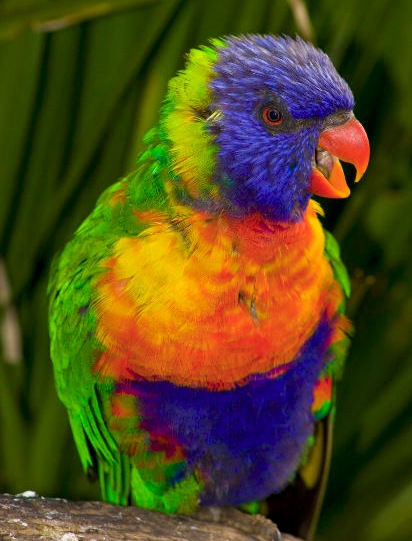 The various colors of beasts and birds represent different conditions of our affections and thoughts. White birds represent pure thoughts, from truth. Birds that are black represent the dark thoughts which arise from the darkness of ignorance, or from falsity. Speckled birds represent thoughts of a mixed character. We read, in Jer. xii. 9, "Mine inheritance is unto Me as a speckled bird : the birds round about are against her." Such is the condition of a lukewarm mind, full of mixed thoughts, partly true and partly false. "The birds round about are against her," because all true thoughts, the white birds of the mind, are against what is false in the mixed thoughts ; and the false thoughts, the dark birds of the mind, are against what is white and true in the mixed thoughts. Savage birds represent savage thoughts. Vultures, and other birds that eat carrion, and other filth, correspond to the filthy thoughts which delight in, and feed upon, the filthy things of low and worldly life, the dead things of human selfishness and folly. The various colors of beasts and birds represent different conditions of our affections and thoughts. White birds represent pure thoughts, from truth. Birds that are black represent the dark thoughts which arise from the darkness of ignorance, or from falsity. Speckled birds represent thoughts of a mixed character. We read, in Jer. xii. 9, "Mine inheritance is unto Me as a speckled bird : the birds round about are against her." Such is the condition of a lukewarm mind, full of mixed thoughts, partly true and partly false. "The birds round about are against her," because all true thoughts, the white birds of the mind, are against what is false in the mixed thoughts ; and the false thoughts, the dark birds of the mind, are against what is white and true in the mixed thoughts. Savage birds represent savage thoughts. Vultures, and other birds that eat carrion, and other filth, correspond to the filthy thoughts which delight in, and feed upon, the filthy things of low and worldly life, the dead things of human selfishness and folly.
And so, good, useful and gentle beasts correspond to our good affections. But beasts of prey, fierce and evil beasts, correspond to our evil loves. There is much difference between an ox and a tiger, or a sheep and a wolf, or a lamb and a wild-cat. And so there is much difference between the affections which these different beasts represent.
Thus, we see that beasts and birds are named in the Scriptures, to represent human affections and human thoughts. And they represent these things because they correspond to them. Without such an inward meaning, how could we understand many of the texts of the Scriptures ? In Ezek. xvii., how shall we understand the parable of the great eagles? It is not fully explained in the subsequent verses about the kings of Babylon and Jerusalem, for these verses are, themselves, symbolic also of inward things. For the Word of the Lord is not, in any of its parts, merely literal history; it is spiritual history, written in symbolic, correspondential language. In Ezek. xxxix. 17-20, we read, "Speak unto every feathered fowl, and to every beast of the field, assemble yourselves and come; gather yourselves on every side to My sacrifice, that I do sacrifice for you, a great sacrifice upon the mountains of Israel, that ye may eat flesh and drink blood. Ye shall eat the flesh of the mighty, and drink the blood of the princes of the earth, of lambs, or rams, of goats, and of bullocks, all of them fatlings of Bashan. All ye shall eat fat till ye be full, and drink blood till ye be drunken, of My sacrifice which I have sacrificed for you. Thus shall ye be filled at My table, with horses, and chariots, with mighty men, and with all men of war, saith the Lord Jehovih." These things seem literally impossible. But this feast of fat things shall be made to our hearts and our intellects, in the coming of our Lord, in our reception of goodness and truth from Him. ' So, in the Revelation,, the many singular things said about beasts and birds refer to our affections and thoughts. In Rev. xviii. 2, the unregenerate mind is thus vividly pictured : "Babylon is . . , become the habitation of devils, and the hold of every foul spirit, and a cage of every unclean and hateful bird." But the peaceful and beautiful state of the regenerating mind is thus pictured, in Isa. xi. 6-9, "The wolf also shall dwell with the lamb, and the leopard shall lie down with the kid; and the calf, and the young lion, and the failing together ; and a little child shall lead them. And the cow and the bear shall feed their young ones shall lie down together ; and the lion shall eat straw, like the ox. And the sucking child shall play on the hole of the asp, and the weaned child shall put his hand on the den of the cockatrice. They shall not hurt nor destroy, in all My holy mountain; for the earth shall be full of the knowledges of the Lord, as the waters cover the sea." For, in the regenerating mind, the evil and false tendencies of the natural mind are kept in subjection, by the higher principles of the spiritual mind. And the "little child" of the new birth shall lead them all.
Author: Edward Craig Mitchell From Scripture Symbolism 1904
|
|