|
<< John II: Driving the Traders from the Temple >>
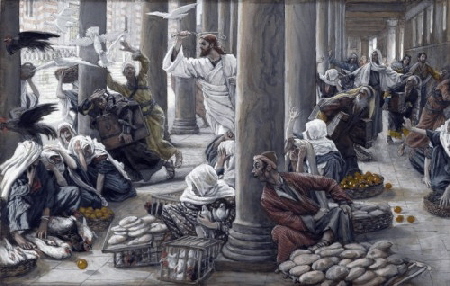 WE remember the Passover, the great feast in the spring of every year, in memory of the deliverance from Egypt. At that time the Jews came from all parts of Palestine and from distant lands to Jerusalem. We remember the beautiful temple with the holy chamber where Zacharias burned the incense. Before the door was the great altar of burnt-offering, where the fire was always burning. About the temple and the altar was the court where priests moved to and fro. A few steps led down to the court of the men of Israel. From this court more steps led under a beautiful gate-way to the court of the women, from which still other steps led to the great court of the Gentiles which reached to the colonnades On the brow of the high city wall. WE remember the Passover, the great feast in the spring of every year, in memory of the deliverance from Egypt. At that time the Jews came from all parts of Palestine and from distant lands to Jerusalem. We remember the beautiful temple with the holy chamber where Zacharias burned the incense. Before the door was the great altar of burnt-offering, where the fire was always burning. About the temple and the altar was the court where priests moved to and fro. A few steps led down to the court of the men of Israel. From this court more steps led under a beautiful gate-way to the court of the women, from which still other steps led to the great court of the Gentiles which reached to the colonnades On the brow of the high city wall.
Some eighteen years had passed since the day when the Lord was found in the temple, among the doctors, hearing and asking questions. It was again the season of the Passover. The city was full of people and especially the temple courts, for they must make ready their lambs for the feast. Many of them had come a long journey and had brought the money to buy the Passover lamb, and doves or oxen for offerings which they might need to make. There were traders ready to sell to the people and at very large prices; and these traders, by paying large rents to the priests, were allowed to set up their stalls and carry on their trade in the very courts of the temple itself. When people came to worship they found men calling out their wares and quarrelling and cheating those who were buying offerings. And there were others who would change the pilgrims' money, for they came from all parts of the country and the world, and brought such money as they had. They must have it changed Jewish money. Every one must have exactly the right coin, a half-shekel silver piece, to pay as a tax to the temple. The moneychangers were often dishonest men, and there was much quarrelling over the coins. And from all this the priests were making gain. How very different from the holy thoughts and prayers with which priests and people should come into the Lord's temple!
This is what the Lord found when He came to the Passover. He drove out the traders and the money-changers, and the courts of the temple were once more quiet for those who came to worship and pray. So He will help us to drive out all that is selfish from ourselves, that He may find a dwelling-place in us. And so He was driving out all selfish thoughts and feelings from His own human life, that it might be the perfect temple and tabernacle of God among men.
And the Jews' passover was at hand, and Jesus went up to Jerusalem. And found in the temple those that sold oxen and sheep and doves, and the changers of money sitting: And when he had made a scourge of small cords, he drove them all out of the temple, and the sheep, and the oxen; and poured out the changers' money, and overthrew the tables; And said unto them that sold doves, Take these things hence; make not my Father's house an house of merchandise. And his disciples remembered that it was written, The zeal of thine house hath eaten me up. Then answered the Jews and said unto him, What sign shewest thou unto us, seeing that thou doest these things? Jesus answered and said unto them, Destroy this temple, and in three days I will raise it up. Then said the Jews, Forty and six years was this temple in building, and wilt thou rear it up in three days? But he spakeof the temple of his body. When therefore he was risen from the dead, his disciples remembered that he had said this unto them; and they believed the scripture, and the word which Jesus had said. Now when he was in Jerusalem at the passover, in the feast day, many believed in his name, when they saw the miracles which he did. But Jesus did not commit himself unto them, because he knew all men, And needed not that any should testify of man: for he knew what was in man.---John II. 13-25.
Author: William L. Worcester 1904
Spiritual Correspondences
Temple at Jerusalem >> Lord's Body >> Heavenly Man where the Lord can dwell >> Divine Humanity >> Divine Presence >> "Behold, the tabernacle of God is with men, and He will dwell with them, and they shall be His people, and God Himself shall be with them, and be their God." Rev.
Driving the traders from the temple >> The purifying work that He was doing, in putting out from His Humanity all selfish and evil things which hindered the full reception of the Divine life >> Overcoming of every thought or wish to use holy things for selfish advantage
Traders in the temple >> Men who were living evil lives and were destroying the temple of the Divine presence in the world
Cleansing the temple >> Purifying work that we should do to make ourselves temples of the Lord
"He knew what was in man." >> The Lord knows our heart and our thoughts (He knew that the belief from just seeing miracles was superficial)
Pictures: James Tissot ----Courtesy of the Brooklyn Museum
|