|
<< Luke XIX: Zaccheus: Parable of the Pounds >>
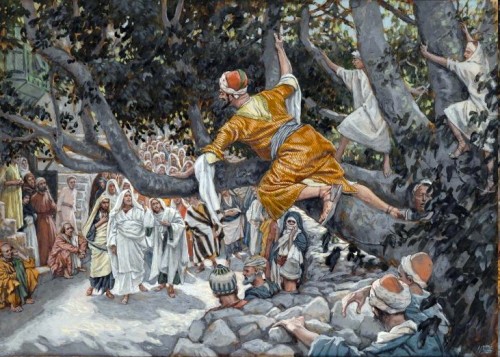 "AND Jesus entered and was passing through Jericho," the fragrant city, between the gardens and under the shade of overhanging trees. There was a man in Jericho who wished to see the Lord, but could not because of the crowd ahout Him. So he ran before, and climbed up into a sycamore tree that shaded the path. The tree was a sycamore-fig, quite different from the trees that we call sycamores. The trees grow very large with great branches near the ground reaching out far from the trunk.They are planted along drives in Cairo, in Egypt, and arch them over with heavy shade.The fruit is a little fig, plenty but not very good. When you read who Zaccheus was, you will see why the people murmured when the Lord went to stay at his house. "AND Jesus entered and was passing through Jericho," the fragrant city, between the gardens and under the shade of overhanging trees. There was a man in Jericho who wished to see the Lord, but could not because of the crowd ahout Him. So he ran before, and climbed up into a sycamore tree that shaded the path. The tree was a sycamore-fig, quite different from the trees that we call sycamores. The trees grow very large with great branches near the ground reaching out far from the trunk.They are planted along drives in Cairo, in Egypt, and arch them over with heavy shade.The fruit is a little fig, plenty but not very good. When you read who Zaccheus was, you will see why the people murmured when the Lord went to stay at his house.
And Jesus entered and passed through Jericho. And, behold, there was a man named Zacchaeus, which was the chief among the publicans, and he was rich. And he sought to see Jesus who he was; and could not for the press, because he was little of stature. And he ran before, and climbed up into a sycomore tree to see him: for he was to pass that way. And when Jesus came to the place, he looked up, and saw him, and said unto him, Zacchaeus, make haste, and come down; for to day I must abide at thy house. And he made haste, and came down, and received him joyfully. And when they saw it, they all murmured, saying, That he was gone to be guest with a man that is a sinner. And Zacchaeus stood, and said unto the Lord: Behold, Lord, the half of my goods I give to the poor; and if I have taken any thing from any man by false accusation, I restore him fourfold. And Jesus said unto him, This day is salvation come to this house, forsomuch as he also is a son of Abraham. For the Son of man is come to seek and to save that which was lost.---Luke XIX. 1-10.
The disciples were expecting, as we know, on this last journey to Jerusalem, that the Lord was now going to make Himself a great earthly king. But the Lord told them in a parable that He was going to leave them to use the little knowledge that He had given them; if they used it well, they would be able to enjoy more power and happiness by and by in heaven.
The Lord told in the parable, of a king going into a far country to receive for himself a kingdom and to return. The people had seen noblemen set out from Palestine to Borne, to receive rule over the country and return. King Herod, and afterwards two of his sons, had gone to Rome for this purpose, and the Jews had sent a message after Archelaus begging that he should not be made king. The '' pound'' given to each servant, means a sum of money equal to about fifteen dollars. It stands for all the knowledge that the Lord gives us to make good use of. We ought to use it, by doing what we know is right. If we do not use it we shall forget it all, when we go into the other world if not before. Then we shall be like the servant who did not use his pound, and it was taken from him.
And as they heard these things, he added and spake a parable, because he was nigh to Jerusalem, and because they thought that the kingdom of God should immediately appear. He said therefore, A certain nobleman went into a far country to receive for himself a kingdom, and to return. And he called his ten servants, and delivered them ten pounds, and said unto them, Occupy till I come. But his citizens hated him, and sent a message after him, saying, We will not have this man to reign over us. And it came to pass, that when he was returned, having received the kingdom, then he commanded these servants to be called unto him, to whom he had given the money, that he might know how much every man had gained by trading. Then came the first, saying, Lord, thy pound hath gained ten pounds. And he said unto him, Well, thou good servant: because thou hast been faithful in a very little, have thou authority over ten cities. And the second came, saying, Lord, thy pound hath gained five pounds. And he said likewise to him, Be thou also over five cities. And another came, saying, Lord, behold, here is thy pound, which I have kept laid up in a napkin: For I feared thee, because thou art an austere man: thou takest up that thou layedst not down, and reapest that thou didst not sow. And he saith unto him, Out of thine own mouth will I judge thee, thou wicked servant. Thou knewest that I was an austere man, taking up that I laid not down, and reaping that I did not sow: Wherefore then gavest not thou my money into the bank, that at my coming I might have required mine own with usury? And he said unto them that stood by, Take from him the pound, and give it to him that hath ten pounds. (And they said unto him, Lord, he hath ten pounds.) For I say unto you, That unto every one which hath shall be given; and from him that hath not, even that he hath shall be taken away from him. But those mine enemies, which would not that I should reign over them, bring hither, and slay them before me. And when he had thus spoken, he went before, ascending up to Jerusalem.---Luke XIX. 11-28.
Author: William L. Worcester 1904
Spiritual Correspondences
The sycamore-fig tree (larger than the orchard fig tree but with much poorer fruit) >> An interest in kind uses, but as yet almost wholly natural and with much that is selfish in it
The nobleman's going into a far country >> The seeming absence of the Lord. He does not let us feel His presence too plainly, for He wants us to be faithful and use His good gifts of our own free will. Otherwise there is no real nobility or happiness in them
One pound, is given to each of the servants >> The Lord knows what will be most favorable for each one in developing a heavenly life
The pound that was not used was taken away >> Knowledge that is not used is soon forgotten; if spiritual knowledge of heavenly things has not become a part of our life by faithfully doing it, it is also taken away
Pictures: James Tissot ----Courtesy of the Brooklyn Museum
|
|