|
<< John II: The Beginning of Miracles >>
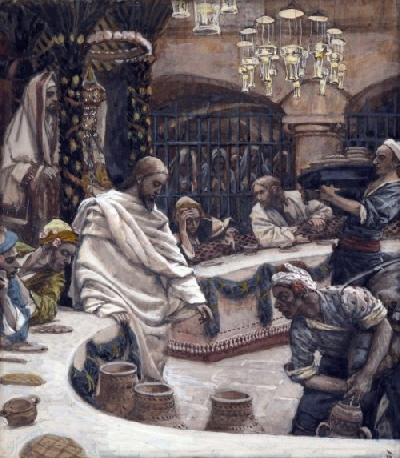 We have followed with the Lord from the Jordan into Galilee, and come now with Him to the little town of Cana, probably the village called Kefr Kenna, just over the hills In the northeast of Nazareth. The flat-roofed stone houses of the little town stand close together on a southwestern hillside. At the foot of the slope is a fine spring of clear water at which the people of the village fill their jars, and the rest runs down in a stream to water the orchards of olives and pomegranates and the grain fields, and out through the little valley into a great meadow. This town was Nathanael's home, and perhaps the Lord was already near Cana when Philip called Nathanael as he sat under the fig tree. We have followed with the Lord from the Jordan into Galilee, and come now with Him to the little town of Cana, probably the village called Kefr Kenna, just over the hills In the northeast of Nazareth. The flat-roofed stone houses of the little town stand close together on a southwestern hillside. At the foot of the slope is a fine spring of clear water at which the people of the village fill their jars, and the rest runs down in a stream to water the orchards of olives and pomegranates and the grain fields, and out through the little valley into a great meadow. This town was Nathanael's home, and perhaps the Lord was already near Cana when Philip called Nathanael as he sat under the fig tree.
"There was a marriage in Cana of Galilee.'' A wedding in that country and in those days was quite different from weddings you have seen. Often the bride and bridegroom prepared for the wedding by fasting and prayer. On the wedding day, often in the evening, the bridegroom went to the bride's home with a party of his friends to bring her to his house with music and rejoicing. As they came they were joined by friends who made a gay procession, carrying lamps and torches and flowers. At the bridegroom's home the marriage feast was ready, and the feasting and rejoicing often lasted for some days. A friend of the bridegroom took charge, called the governor of the feast. We shall remember the procession and the marriage feast when we read of the wise and foolish virgins waiting for the bridegroom, and of the king who made a marriage for his son and at supper lime sent his servants to call those to the marriage. There was a marriage feast in Cana. We think of a low flat-roofed house built about an open court into which the doors and windows of the rooms opened, perhaps under the sheller of a porch or gallery. Low tables were spread, about which the guests reclined on couches, resting on the left arm with the right hand free. By the door were six large stone jars for water, where the guests might wash their hands before and after eating, and where the dishes also might be rinsed according to the strict rules of the Jews. The water for the jars was no doubt brought from the spring at the foot of the hill. We must read about the marriage in Cana, and the first miracle which showed the disciples the Lord's wonderful power.
And the third day there was a marriage in Cana of Galilee; and the mother of Jesus was there: And both Jesus was called, and his disciples, to the marriage. And when they wanted wine, the mother of Jesus saith unto him, They have no wine. Jesus saith unto her, Woman, what have I to do with thee? mine hour is not yet come. His mother saith unto the servants, Whatsoever he saith unto you, do it. And there were set there six waterpots of stone, after the manner of the purifying of the Jews, containing two or three firkins apiece. Jesus saith unto them, Fill the waterpots with water. And they filled them up to the brim. And he saith unto them, Draw out now, and bear unto the governor of the feast. And they bare it. When the ruler of the feast had tasted the water that was made wine, and knew not whence it was: (but the servants which drew the water knew;) the governor of the feast called the bridegroom, And saith unto him, Every man at the beginning doth set forth good wine; and when men have well drunk, then that which is worse: but thou hast kept the good wine until now. This beginning of miracles did Jesus in Cana of Galilee, and manifested forth his glory; and his disciples believed on him.---John II. 1-11.
Author: William L. Worcester 1904
Spiritual Correspondences
The outward circumstances of the Lord's life in the world and the outward events in which He took part >> Spiritual experiences of His life and our lives
Feast >> Type of the heavenly life in which there is abundant reception of true thought and good affection
Marriage feast >> Heavenly feast >> Marriage of truth and goodness and marriage of the soul with the Lord
Marriage in Cana (Nathaniel's hometown) >> Heavenly marriage beginning in simple hearts
"the mother of Jesus was there: and both Jesus was called and His disciples, to the marriage." >> The blessed state belonged to the Lord's life and was beginning to be experienced from Him by the Church and the disciples
Wine >> Knowledge of the ways of heavenly life made sweet by a happy perception of the goodness and blessedness of those ways
Water pots were filled with cleansing water in preparation for the giving of the wine >> The need, when inspiration fails, of learning what is right, repenting of evil, and doing good as a duty to the Lord
Six water pots filled to the brim >> All states of dutiful life and thoroughness in repenting and doing right
The Lord was thirty years old >> The Lord had replaced the human by the Divine and become glorified
Miracles >> Manifestation of His glory
"Woman, what have I to do with thee?" >> The power to perform miracles had nothing to do with earthly nature (Earthly mother, Mary)
He no longer called Mary His mother >> His human was replaced by the Divine ["That the Lord was the Son of Mary is true, but that He is so still is not true."E. Swedenborg]
Miracles >> Confirmation of faith with those who feel His Divineness in their hearts
Pictures: James Tissot ----Courtesy of the Brooklyn Museum
|