|
<< Matthew 3: The Lord's Baptism at the Jordan >>
 WE once sat together on the Mount of Olives looking down upon the temple and the houses of Jerusalem. To-day let us go over the crest of the hill following this road which leads to Jericho. On the slope of the Mount of Olives we pass the little town of Bethany, looking out towards the south and east over the barren hills of the wilderness. A short day's journey on this rough road, among the brown, dry hills, brings us to the brow of the high cliffs which overlook the plain of the Jordan. It is a sunny plain some eight miles wide, between these hills on which we stand and the blue mountains which rise as a wall on its eastern side. Along the middle of the plain a line of dark green shows where the Jordan runs, and following the line towards the south we see the dark blue water of the Dead Sea. This plain is really a deep trough in the earth's surface, so deep that if a channel should be cut to let in the water from the Mediterranean it would rise to the hill tops where we stand. WE once sat together on the Mount of Olives looking down upon the temple and the houses of Jerusalem. To-day let us go over the crest of the hill following this road which leads to Jericho. On the slope of the Mount of Olives we pass the little town of Bethany, looking out towards the south and east over the barren hills of the wilderness. A short day's journey on this rough road, among the brown, dry hills, brings us to the brow of the high cliffs which overlook the plain of the Jordan. It is a sunny plain some eight miles wide, between these hills on which we stand and the blue mountains which rise as a wall on its eastern side. Along the middle of the plain a line of dark green shows where the Jordan runs, and following the line towards the south we see the dark blue water of the Dead Sea. This plain is really a deep trough in the earth's surface, so deep that if a channel should be cut to let in the water from the Mediterranean it would rise to the hill tops where we stand.
It is a beautiful green plain wherever it is watered by springs and streams. By our side where we stand there is a chasm, between the brightly colored cliffs, so deep that we can hardly see the brook which we hear running in the bottom. This brook is the Kelt, supposed by some to be the Cherith of the old time, by which Elijah was hid when the ravens brought him food. Where the brook runs out into the plain just at our feet, the city of Jericho stood in the New-Testament days, surrounded by its gardens and orchards. As we go down the hill to cross the plain towards the Jordan we see some ruins of the city.
Turn a little towards the north across the sunny meadows. As we draw near the river the ground breaks steeply down to a lower level. This lower plain, a mile or so in width, is filled with a thicket of trees among which the Jordan runs. It is a swift stream about one hundred feet in width, and there are places where it usually may be forded. Here and there is an opening among the trees with a stony beach by the water's side. At a place called Bethabara—perhaps at the ford a little below the Sea of Galilee —the people, long ago, were gathering from Jerusalem and Judaea, and the country round about Jordan. They had come to hear a man of the desert, who preached repentance. John the Baptist was a man with weather-beaten face and with uncut hair; for he was a Nazarite, one set apart in the service of the Lord, he wore a garment of coarse camel's hair cloth bound with a leathern girdle. His home had been in the deserts bordering the Dead Sea, and his food had been the great brown locusts (grasshoppers, the children would call them), and wild honey. Even to-day the poor Arabs eat the locusts, drying their bodies and stewing them or mixing them with other food. The wild honey was plentiful in the wilderness, for in the rainy winter there were many flowers from which the bees gathered it and laid it away in the caves of the rocks.
John had lived in the desert, but now he was sent to baptize and to make ready a people prepared for the Lord. Read the story, and how the Lord Himself came to be baptized by John in the Jordan.
In those days came John the Baptist, preaching in the wilderness of Judaea, And saying, Repent ye: for the kingdom of heaven is at hand. For this is he that was spoken of by the prophet Esaias, saying,
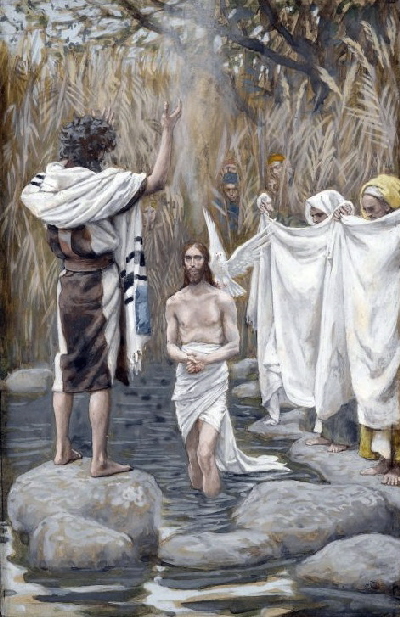
And the same John had his raiment of camel's hair, and a leathern girdle about his loins; and his meat was locusts and wild honey. Then went out to him Jerusalem, and all Judaea, and all the region round about Jordan, And were baptized of him in Jordan, confessing their sins. But when he saw many of the Pharisees and Sadducees come to his baptism, he said unto them, O generation of vipers, who hath warned you to flee from the wrath to come? Bring forth therefore fruits meet for repentance: And think not to say within yourselves, We have Abraham to our father: for I say unto you, that God is able of these stones to raise up children unto Abraham. And now also the axe is laid unto the root of the trees: therefore every tree which bringeth not forth good fruit is hewn down, and cast into the fire. I indeed baptize you with water unto repentance. but he that cometh after me is mightier than I, whose shoes I am not worthy to bear: he shall baptize you with the Holy Ghost, and with fire: Whose fan is in his hand, and he will throughly purge his floor, and gather his wheat into the garner; but he will burn up the chaff with unquenchable fire. Then cometh Jesus from Galilee to Jordan unto John, to be baptized of him. But John forbad him, saying, I have need to be baptized of thee, and comest thou to me? And Jesus answering said unto him, Suffer it to be so now: for thus it becometh us to fulfil all righteousness. Then he suffered him. And Jesus, when he was baptized, went up straightway out of the water: and, lo, the heavens were opened unto him, and he saw the Spirit of God descending like a dove, and lighting upon him: And lo a voice from heaven, saying, This is my beloved Son, in whom I am well pleased.---Matthew III
Author: William L. Worcester 1904
Spiritual Correspondences
John lived in the deserts and preached in the wilderness >> Barren state of the Jewish Church before the coming of the Lord
John wore a cloak of camel's hair and a leathern girdle about his loins >> Natural intelligence of one who is learning and applying the literal commandments of God's Word
John's food was locusts and wild honey >> True but superficial thought from the letter of the Word and pleasantness of learning and applying it
Washing and baptism >> The cleansing of repentance
Water >> Truth that teaches what is right and what is wrong and enables us to recognize and separate the evil
Water of the Jordan >> Truth from the letter of the Word
Baptism of the Holy Spirit and fire >> Interior cleansing and renewing of the soul by Divine truth and goodness from the Lord
Lord submitting to be baptized by John >> The Lord testified to the cleansing of the natural life by the truth of the Word
The dove descending and lighting upon Him >> The reception of the Spirit of God in the Human, according to its purification
The voice from heaven >> The Divine satisfaction in the human work among men
Spiritual Meaning
His first appearance was at the baptism of John ; where, by submitting to be baptized, He testified to the cleansing of the natural life by the truth of the Word. And where also the dove descending and lighting upon Him testified to the reception of the Spirit of God in the Human, according to its purification. The voice from heaven testified to the Divine satisfaction in the human work among men. (Author: John Worchester, 1898. Matthew's Gospel.)
Pictures: James Tissot ----Courtesy of the Brooklyn Museum
|
|