|
<< Matthew XVIII: Real Greatness: Forgiveness >>
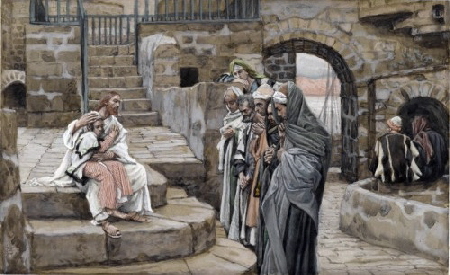 THEY were still at Capernaum, where the fish had brought the tribute money to Peter. On the way to Capernaum the disciples had disputed among themselves who should be the greatest. They knew that the Lord was a king, and they expected that He would establish a great earthly kingdom like the Roman Empire, only larger and greater. They thought that they should be rulers in this kingdom, and hoped that they should have places near to the king. They were thinking of such things as they walked to Capernaum. THEY were still at Capernaum, where the fish had brought the tribute money to Peter. On the way to Capernaum the disciples had disputed among themselves who should be the greatest. They knew that the Lord was a king, and they expected that He would establish a great earthly kingdom like the Roman Empire, only larger and greater. They thought that they should be rulers in this kingdom, and hoped that they should have places near to the king. They were thinking of such things as they walked to Capernaum.
Now they were in the house with the Lord. He knew their thoughts and what they had been saying. Would it please Him to have them thinking of His kingdom in this way, each one wanting the first place and the most power, or would it grieve Him! In heaven they are greatest who are most humble and most useful. The Lord Himself is the patient servant of all.
The Lord taught the disciples what real greatness is, when He called a little child and set him in the midst of them. What a different kind of greatness from that which they had hoped for! The Lord loves little children, and He says that His angels are always near to them. So too the Lord and angels are near to all that is innocent in every heart.
At the same time came the disciples unto Jesus, saying, Who is the greatest in the kingdom of heaven? And Jesus called a little child unto him, and set him in the midst of them, And said, Verily I say unto you, Except ye be converted, and become as little children, ye shall not enter into the kingdom of heaven. Whosoever therefore shall humble himself as this little child, the same is greatest in the kingdom of heaven. And whoso shall receive one such little child in my name receiveth me. But whoso shall offend one of these little ones which believe in me, it were better for him that a millstone were hanged about his neck, and that he were drowned in the depth of the sea. Woe unto the world because of offences! for it must needs be that offences come; but woe to that man by whom the offence cometh! Wherefore if thy hand or thy foot offend thee, cut them off, and cast them from thee: it is better for thee to enter into life halt or maimed, rather than having two hands or two feet to be cast into everlasting fire.And if thine eye offend thee, pluck it out, and cast it from thee: it is better for thee to enter into life with one eye, rather than having two eyes to be cast into hell fire. Take heed that ye despise not one of these little ones; for I say unto you, That in heaven their angels do always behold the face of my Father which is in heaven. For the Son of man is come to save that which was lost. How think ye? if a man have an hundred sheep, and one of them be gone astray, doth he not leave the ninety and nine, and goeth into the mountains, and seeketh that which is gone astray? And if so be that he find it, verily I say unto you, he rejoiceth more of that sheep, than of the ninety and nine which went not astray. Even so it is not the will of your Father which is in heaven, that one of these little ones should perish.---Matthew XVII. 1-14.
The Lord also told the disciples, and He tells us, that we must learn to be forgiving, or He cannot forgive us.
Then came Peter to him, and said, Lord, how oft shall my brother sin against me, and I forgive him? till seven times? Jesus saith unto him, I say not unto thee, Until seven times: but, Until seventy times seven. Therefore is the kingdom of heaven likened unto a certain king, which would take account of his servants. And when he had begun to reckon, one was brought unto him, which owed him ten thousand talents. But forasmuch as he had not to pay, his lord commanded him to be sold, and his wife, and children, and all that he had, and payment to be made. The servant therefore fell down, and worshipped him, saying, Lord, have patience with me, and I will pay thee all. Then the lord of that servant was moved with compassion, and loosed him, and forgave him the debt. But the same servant went out, and found one of his fellowservants, which owed him an hundred pence: and he laid hands on him, and took him by the throat, saying, Pay me that thou owest. And his fellowservant fell down at his feet, and besought him, saying, Have patience with me, and I will pay thee all. And he would not: but went and cast him into prison, till he should pay the debt. So when his fellowservants saw what was done, they were very sorry, and came and told unto their lord all that was done. Then his lord, after that he had called him, said unto him, O thou wicked servant, I forgave thee all that debt, because thou desiredst me: Shouldest not thou also have had compassion on thy fellowservant, even as I had pity on thee? And his lord was wroth, and delivered him to the tormentors, till he should pay all that was due unto him. So likewise shall my heavenly Father do also unto you, if ye from your hearts forgive not every one his brother their trespasses.---Matthew XVIII. 21-35.
Author: William L. Worcester 1904
Spiritual Correspondences
Childlike spirit >> The spirit which knows that we have no goodness and no strength of our own, but is humbly dependent on the Lord; It is strong because it trusts His strength. It is wise because it is willing to be taught by Him
Ass-millstone >> Truth or falsity of the natural mind, of a worldly scientific sort
"It must needs be that offenses come." >> Contact with evil and experience of evil, but it is dangerous only to the extent that we make it our own and so are responsible for it
The foot >> The outmost plane of life, in contact with the world
The hand >> Actions
The eye >> Thoughts
The hand and foot that are to be cut off, and the eye that is to be plucked out >> The act or thought which is selfish and evil, that the life may be single in its service of the Lord
Forgive Seventy times seven >> "Forgive always; forgive till the desire to be unforgiving is gone, and the heavenly spirit of perfect forgiveness is gained." E. Swedenborg
Fellow servants to the Lord, our King >> We are called servants especially in the early stages of regeneration, while we act more from a sense of duty than from loving freedom
The servants are brought to the king >> We are to consider our relation to the Lord
The command to sell >> The impossibility of making just return to the Lord, even if all that we have, and all that we are, is put absolutely at His service
The wife and children >> Faculties and developments of one's own life
Seizing by the throat, choking the flow of life between the head and the body >> By being selfish and unforgiving toward our fellow servant we close up the channels of life from within. These same hard feelings and thoughts become tormentors from which there is no escape till our hearts are made right toward our neighbor and so toward the Lord
Fellow servants >> External faculties of our own life, which we are slow to bring into right relation to the Lord
Spiritual Meaning
LAST APPEALS IN GALILEE.
THERE follows now the series of discourses which go so deep into the hearts of men, and reveal so deeply the saving love of the Father in the Lord. The disciples were thinking of greatness in the kingdom of heaven a thought which has never yet left the Christian Church. But the Lord told them that to be a little child, to claim nothing for self and desire nothing for self, was the greatness of heaven ; and to lose this innocence was to sink into the depths of the sea.
Experience of evil would come with the development of the natural life, but it was to be rejected as soon as recognized. Whatever appealed -to one's self-love, by allurement or flattery or self indulgence, was to be rejected, that the life might be simple, from God, and obedient. Whatever suggested a thought of evil with desire, was to be rejected, that the idea of God and heaven might ever be before the mind. Innocence as of little children would always behold the face of the Father in Heaven. It was such innocence as this that the Lord had come to recover. It existed in the ninety and nine in heaven ; but here upon earth it had almost perished. In its tenderness arid gratefulness when rescued He would greatly rejoice.
He had come as a brother to brethren to save and not to condemn to show them their fault and their danger, that they might hear and be saved. He was ready to illustrate in every way, by what was good and what was true and what was practically useful or necessary. He was ready to appeal to all that was known of good life or of the teachings of God. If all was rejected, men still were not condemned ; they themselves refused the good of heaven. What they accepted or refused on earth, they would accept or refuse for ever.
Thus was He working for men, and so must His disciples work. And wherever they worked from both love and truth, His spirit would be in them, and the Divine blessing would be in their work.
The spirit of forgiveness is the supreme test of the quality of the church. The faith of the church, represented by Peter, was ready to forgive as a duty as often as it was required. But true charity would forgive endlessly. So does the Lord forgive. For all that one has and is he is indebted to the Lord, and he can pay the debt only by devoting all that he has and is to the Lord's service. The Lord forgives him the debt gives him his freedom, that he may pay as he will. If he from his heart forgives others, his powers are in the Lord's service, and he is paying the debt as he can. But if he does not forgive, even the Infinite Mercifulness cannot save him from the torment of a cankered heart and acrid thought, which no kindness can relieve. (Author: John Worchester, 1898. Matthew's Gospel.)
Pictures: James Tissot ----Courtesy of the Brooklyn Museum
|
|