|
<< Luke XIX, Mark XI: Entry into Jerusalem >>
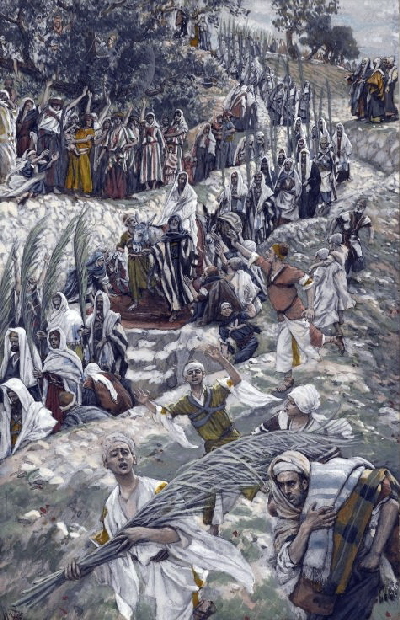
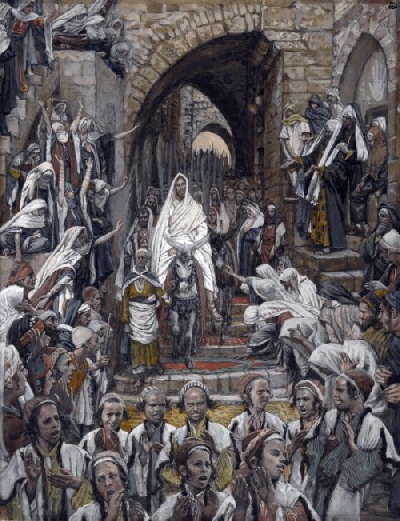 THE Sabbath, the day of rest, was passed in Bethany. It was now the first day of the week, and companies of pilgrims were passing over the Mount of Olives into Jerusalem. It was the day that we remember as Palm Sunday. Near to Bethany, where the path to the village branched from the path which was in those days the main road over the Mount of Olives, there was another village, Bethphage. The Lord sent two disciples to this village to bring a young ass on which He would ride. The disciples laid their garments on the ass, and the Lord rode upon him. And many spread their garments as a carpet on the road, and others scattered branches, leafy and perhaps bright with flowers. THE Sabbath, the day of rest, was passed in Bethany. It was now the first day of the week, and companies of pilgrims were passing over the Mount of Olives into Jerusalem. It was the day that we remember as Palm Sunday. Near to Bethany, where the path to the village branched from the path which was in those days the main road over the Mount of Olives, there was another village, Bethphage. The Lord sent two disciples to this village to bring a young ass on which He would ride. The disciples laid their garments on the ass, and the Lord rode upon him. And many spread their garments as a carpet on the road, and others scattered branches, leafy and perhaps bright with flowers.
So they climbed to the ridge of the Mount of Olives. The Lord was riding on an ass, as kings and judges rode in the days of Samuel and David. The disciples and all the people thought that the kingdom of God should immediately appear. It had long ago been said by the prophet Zechariah, "Rejoice ' greatly, 0 daughter of Zion; shout, 0 daughter of Jerusalem: behold, thy King cometh unto thee: he is just, and having salvation; lowly, and riding upon an ass, and upon a colt the foal of an ass," though it was not till afterwards that the disciples remembered this prophecy and saw how it had been fulfilled.
They reached the brow of the Mount of Olives, and Jerusalem lay before them on its hills. There was Mount Zion with the great palace of Herod, now used by Pilate, with frowning walls and towers. Under the hills were the busy streets of the city, and reaching away to the north were houses and gardens. Just opposite the Mount of Olives stood the temple, high above the Kidron valley, the shining building with its wide courts about it trimmed gaily for the feast and thronged with people. Remember how the pilgrims used to sing, "I was glad when they said unto me, Let us go unto the house of the Lord. Our feet shall stand within thy gates, O Jerusalem," and other Psalms of rejoicing. The disciples and the people who were with the Lord shouted joyfully. They remembered all the mighty works which they had seen, and hoped that the kingdom was at hand, "Hosanna," they cried, which means "save now." "Hosanna to the son of David: Blessed is he Ihal cometh in the name ol' the Lord; Hosanna in the highest."
The multitudes in the temple courts learned that the Lord was coming; perhaps they heard the shouts and singing from the hill. Many people took branches of palm trees, Ihe large Feather-shaped leaves from the date-palms which probably then were plentiful in the valley and on the hillside,---and went forth to meet Him. They went out by the eastern gate of the city, crossed over the Kidron bridge and up the hill, and joined in the cries, '' Hosanna! Hosanna in the highest!"
But amid all this rejoicing, and with the glorious city before Him, the Lord was sad. He did not come to be an earthly king, and hopes of a great earthly kingdom were not what He wished to see in the hearts of his disciples, He knew that soon all the glory of the city Jerusalem would pass away. Not many years and the Roman armies would come, and would encamp on this very hill, and the city would be overthrown. The Lord wept over the city, saying, "If thou hadst known, even thou, at least in this thy day, the things which belong unto thy peace." Yet it was not the overthrow of the city for which the Lord wept, but the wickedness of the people. So the company passed down the hill across the Kidron and up into the city.
And it came to pass, when he was come nigh to Bethphage and Bethany, at the mount called the mount of Olives, he sent two of his disciples, Saying, Go ye into the village over against you; in the which at your entering ye shall find a colt tied, whereon yet never man sat: loose him, and bring him hither. And if any man ask you, Why do ye loose him? thus shall ye say unto him, Because the Lord hath need of him. And they that were sent went their way, and found even as he had said unto them. And as they were loosing the colt, the owners thereof said unto them, Why loose ye the colt? And they said, The Lord hath need of him. And they brought him to Jesus: and they cast their garments upon the colt, and they set Jesus thereon. And as he went, they spread their clothes in the way. And when he was come nigh, even now at the descent of the mount of Olives, the whole multitude of the disciples began to rejoice and praise God with a loud voice for all the mighty works that they had seen; Saying, Blessed be the King that cometh in the name of the Lord: peace in heaven, and glory in the highest. And some of the Pharisees from among the multitude said unto him, Master, rebuke thy disciples. And he answered and said unto them, I tell you that, if these should hold their peace, the stones would immediately cry out.
And when he was come near, he beheld the city, and wept over it, Saying, If thou hadst known, even thou, at least in this thy day, the things which belong unto thy peace! but now they are hid from thine eyes. For the days shall come upon thee, that thine enemies shall cast a trench about thee, and compass thee round, and keep thee in on every side, And shall lay thee even with the ground, and thy children within thee; and they shall not leave in thee one stone upon another; because thou knewest not the time of thy visitation.---Luke XIX. 29-44.
And Jesus entered into Jerusalem, and into the temple: and when he had looked round about upon all things, and now the eventide was come, he went out unto Bethany with the twelve.---Mark XI. 11.
Author: William L. Worcester 1904
Spiritual Correspondences
Escorting the Lord into Jerusalem with the shouting of hosannas and the waving of palms (as in Revelation 7:9-17) >> Real welcome of the King and a real rejoicing in His saving power >> Gratefulness for the Lord's help in temptation
The palms in the hands of the multitudes >> Victory of Truth over temptation
Lord's riding on the ass >> His coming to bring order into our natural thought and life
(In Revelation, the Lord is riding on a white horse >> His coming in the power of spiritual understanding and the Truth of the Word)
The spreading of garments upon the ass >> The utter subjection of ourselves, especially of our thoughts, to the Lord's rule and guidance
"If these should hold their peace, the stones would immediately cry out." >> The fact that the Lord was King is a truth that could not be suppressed
He beheld the city (Jerusalem), and wept over it >> The Lord's sorrow for the destruction of the spiritual Jerusalem, the church, the lifeless condition of the Jewish Church at that day and the lifeless condition which the Lord saw would come in the Christian Church
Spiritual Meaning
EXPLORATION OF THE TEMPLE OF GOD.
 WE have dwelt long upon the Lord's work on the plane of conduct, and have followed His exploration of the plane of motives, by which the conduct is connected with the Divine. Now we come to the direct relation of the soul with the Divine Presence. That Presence existed representatively in the temple at Jerusalem. It had been felt in an innocent unrational way by the earliest church upon earth. It had been known rationally, its quality perceived in contrast with the inner self, by no one. A new development of the rational faculty, capable of apprehending these deeper things in the soul, was necessary before this could be grasped, and the inmost conscious mind set in order for the dwelling-place of the Divine. This rational development then existed in the Lord alone, and is only now slowly taking place in the human race. And this is meant by the colt, the foal of an ass, on which never man sat, on which Jesus now came to explore the temple and the church at Jerusalem. The ass also was with the colt ; for the new understanding is supported by the old, and is not different from it except in being a new development of it. As a King the Lord came, the King of the daughter of Zion, because He was now the supreme truth which was to set humanity from its inmosts in true relation to God. They put their clothes upon the colt, or spread them in the way, and cut down branches from the trees and strewed them in the way, representing the submission of all forms of life and all perceptions of truth to this supreme truth of the relation of man to God. They cried, " Hosanna to the Son of David; Blessed is He that cometh in the name of the Lord ; Hosanna in the Highest," because in Him and through Him God was now the Saviour of men. WE have dwelt long upon the Lord's work on the plane of conduct, and have followed His exploration of the plane of motives, by which the conduct is connected with the Divine. Now we come to the direct relation of the soul with the Divine Presence. That Presence existed representatively in the temple at Jerusalem. It had been felt in an innocent unrational way by the earliest church upon earth. It had been known rationally, its quality perceived in contrast with the inner self, by no one. A new development of the rational faculty, capable of apprehending these deeper things in the soul, was necessary before this could be grasped, and the inmost conscious mind set in order for the dwelling-place of the Divine. This rational development then existed in the Lord alone, and is only now slowly taking place in the human race. And this is meant by the colt, the foal of an ass, on which never man sat, on which Jesus now came to explore the temple and the church at Jerusalem. The ass also was with the colt ; for the new understanding is supported by the old, and is not different from it except in being a new development of it. As a King the Lord came, the King of the daughter of Zion, because He was now the supreme truth which was to set humanity from its inmosts in true relation to God. They put their clothes upon the colt, or spread them in the way, and cut down branches from the trees and strewed them in the way, representing the submission of all forms of life and all perceptions of truth to this supreme truth of the relation of man to God. They cried, " Hosanna to the Son of David; Blessed is He that cometh in the name of the Lord ; Hosanna in the Highest," because in Him and through Him God was now the Saviour of men.
In the temple He found those that sold and bought, the money-changers and them that sold doves true examples and representatives of the human self in its disposition to make gain of holy truths and holy goods, to appropriate to self and make gain from even the light and the love of the Spirit of God.
He healed there the blind and the lame those who knew not and yet would know the reality of the Divine Presence revealed only in Him ; and those who felt their inability to live from it, as no man could but from Him. And there the children cried Hosanna, in innocent recognition. But the chief priests and scribes, representing the selfish pride in holy good and in holy truth from God, were sore displeased.
In Bethany, where Lazarus was, representing a new charity from the Spirit of God, He lodged ; and from there returned to the city. He hungered for something good from those with whom the Presence of God vainly rested. But they were a tree with knowledge from the Word, but no good of life. And now their end was come, and the kingdom was to depart from them. He tested them by their recognition of the Divine authority of the truth of life which John taught ; but to them it had no such authority. And to whom that basis of acknowledgment is lacking, there can be no recognition of the Divine in deeper truth.
Those who had sinned through love of the world and of pleasure, suffered themselves to be corrected and saved. But to those who professed to love holy things, but instead of correcting their lives by them used them to justify and exalt self, no salvation was possible.
The vineyard of God had been placed in their care, but every demand for the fruits of it they had resented ; and now they would destroy Him Whom the Father's Love had sent to save them Who was that saving Love itself teaching and reasoning with them.
And yet He Whom they rejected would be the corner stone of a new church which now would rise as they should pass away. Some might unheedingly stumble upon it, as did the publicans and harlots, and would suffer for their heedlessness ; but they upon whom it should fall, in total condemnation of their misuse of the truth, would be ground to powder. They saw now that they must destroy Him, or they would be destroyed. (Author: John Worchester, 1898. Matthew's Gospel.)
Pictures: James Tissot ----Courtesy of the Brooklyn Museum
|
|