|
<< Mark VII: The Syrophoenician's Daughter >>
 IF we journey northward from the Sea of Galilee we pass through a country of fine hills and deep valleys. From the hill-tops we have grand views of Mount Hermon white with snow, and soon, also, of the still higher Lebanon. We turn more westward, and by and by we look down from the hills upon the great Mediterranean Sea. A low, green plain with a sandy margin stretches along the shore, and a point of land, larger at the end, reaches out, into the sea. On this is a little town, all that is left of the old city of Tyre. IF we journey northward from the Sea of Galilee we pass through a country of fine hills and deep valleys. From the hill-tops we have grand views of Mount Hermon white with snow, and soon, also, of the still higher Lebanon. We turn more westward, and by and by we look down from the hills upon the great Mediterranean Sea. A low, green plain with a sandy margin stretches along the shore, and a point of land, larger at the end, reaches out, into the sea. On this is a little town, all that is left of the old city of Tyre.
In the old time the city stood on the shore, and on two rocky islands which gave shelter to the ships as they lay at anchor. The ships from Tyre went through all the Mediterranean and far along the coasts of Africa and Europe, and brought home precious things to trade. Remember how the Tyrian workmen and sailors helped king Solomon. In the old days Tyre was wonderfully rich and beautiful. We can read about it in Ezekiel xxvii. "0 Tyrus, thou hast said, I am of perfect beauty. Thy borders are in the midst of the seas, thy builders have perfected thy beauty." The island city was very strong. But at last the conqueror Alexander, with his army, destroyed the city on the shore, and used its stones to build a way out to the island. The sands have washed in upon the causeway which he built, and it is an island no more. All this was long before our Gospel story.
The sister city, Sidon, was further up the shore. The people of Tyre and Sidon were not Israelites, and they did not know the Lord and His commandments. They worshipped idols and the sun and moon and stars.
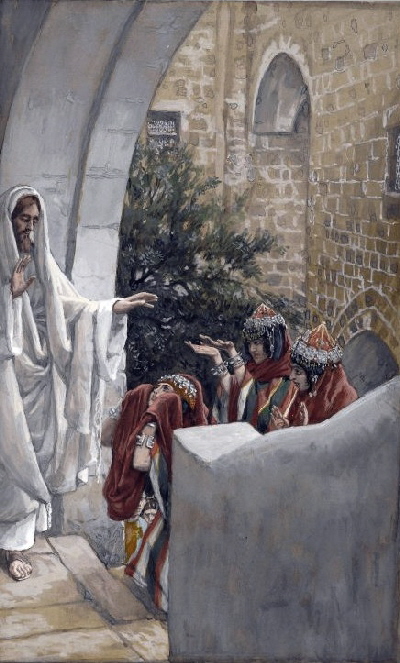
The Lord came into the borders of the land of Tyre and Sidon, but even here He was not hid. A woman whose daughter was possessed with a devil, cried to Him to help her. Remember how in those days evil spirils had power over people, but the Lord's power drove them out. The woman was a Canaanite, as the people of the lowlands by the sea and Jordan were called. She was a Greek, which means a Gentile and not a Jew. She is called also a Syrophoenician. The people of Tyre and Sidon were Phoenicians, but they had planted many colonies in other places on the Mediterranean shore, especially in Africa, so that the name Syrophcenician was used to mean those Phoenicians still living in Syria. The disciples asked the Lord to send her away, and the Lord's own words sounded at first as if he could not help her. We know that the Lord loved the woman and wished to help her, but she must first know that the help came not from a mere man, and not from an idol, but from the Lord, who had revealed Himself to the people of Israel. When she confessed humbly that she looked up to the Lord of Israel as dogs look for crumbs from their master's table, then she could receive the help she asked.
And from thence he arose, and went into the borders of Tyre and Sidon, and entered into an house, and would have no man know it: but he could not be hid. For a certain woman, whose young daughter had an unclean spirit, heard of him, and came and fell at his feet: The woman was a Greek, a Syrophenician by nation; and she besought him that he would cast forth the devil out of her daughter. But Jesus said unto her, Let the children first be filled: for it is not meet to take the children's bread, and to cast it unto the dogs. And she answered and said unto him, Yes, Lord: yet the dogs under the table eat of the children's crumbs. And he said unto her, For this saying go thy way; the devil is gone out of thy daughter. And when she was come to her house, she found the devil gone out, and her daughter laid upon the bed.---Mark VII. 24-30.
Author: William L. Worcester 1904
Spiritual Correspondences
The land of Israel >> Spiritual life
Neighboring lands >> Natural states or faculties which are good if they minister to spiritual life
Visit of the Lord to the borders of Tyre and Sidon >> His desire to help people in natural, Gentile states
The Phoenicians, the sailors and traders of the world >> Our faculty for gathering in and for imparting all kinds of natural knowledge
Animals >> Human affections
Dogs >> Affections of external, natural kinds, sometimes self-indulgent, sometimes kind in a simple, ignorant way
The children >> Developments of spiritual life
The dogs under the table eat of the children's crumbs >> Lower affections expanding into a Love of Heavenly Life
Pictures: James Tissot ----Courtesy of the Brooklyn Museum
|